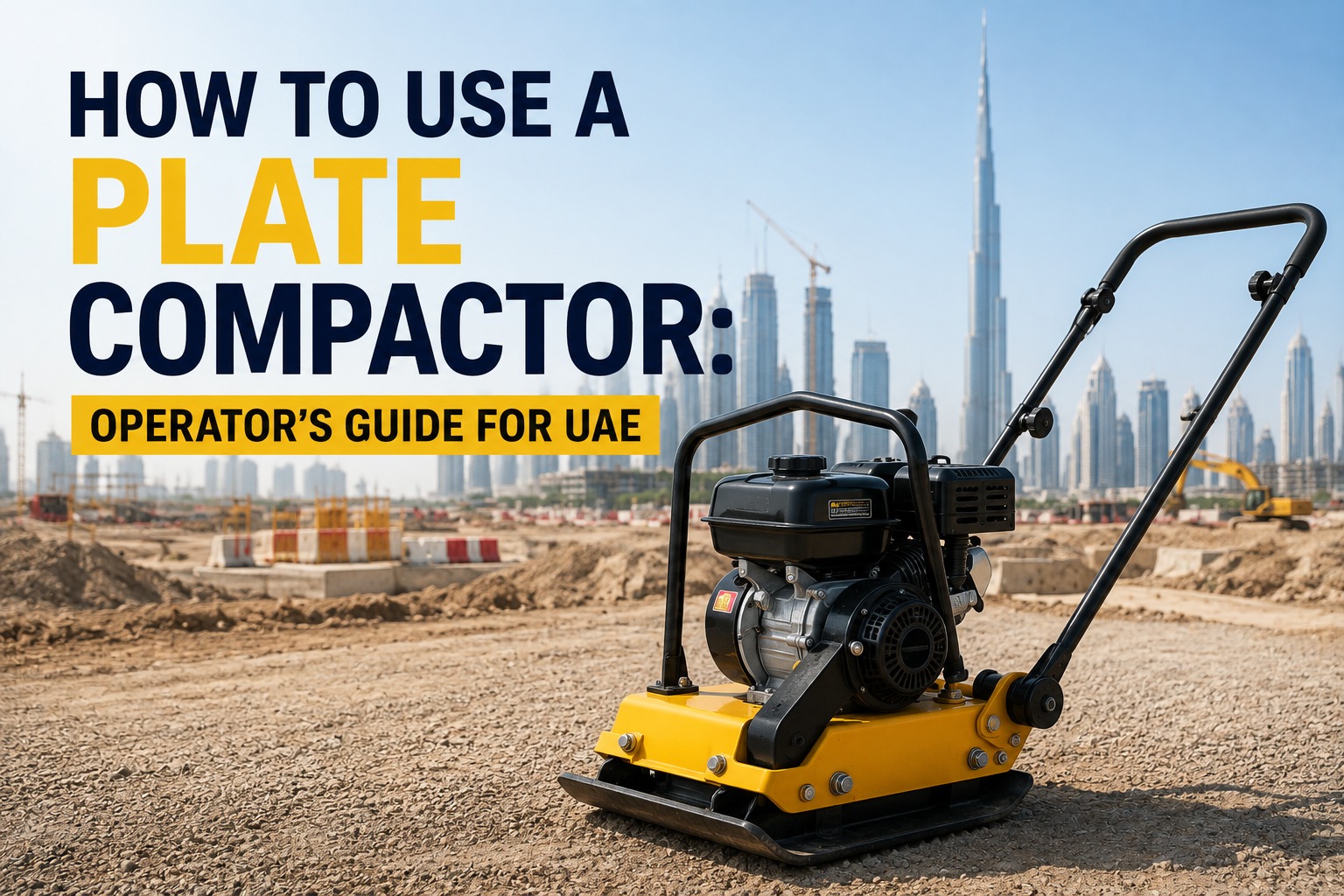
A plate compactor looks like the simplest machine on site — start it, hold on, walk. Which is exactly why so much compaction gets failed by the testing lab. The machine did its part; the operator ran it on a layer twice too thick, on soil bone-dry from the sun, in single passes with gaps between runs. None of that shows until the density test does.
Here's how to run a plate properly: preparation, layer depths, pass counts, moisture, and the handful of mistakes behind almost every failed compaction test we hear about. Ten minutes of reading that saves a day of rework.
This guide is written around 90 kg-class machines like our Baylorr BAY-PC90C, but the method applies across the compaction range up to the 160 kg BAY-PC160H.
Before You Start: Three Checks That Take Two Minutes
- The ground: clear debris, rebar offcuts and anything that shouldn't be sealed into the layer. Confirm the fill is spread evenly — a plate compacts what's there; it doesn't level for you.
- The moisture: squeeze a handful of the fill. It should hold together like damp sand, not crumble to dust or drip. In UAE heat, fill that was fine at 7 am is dust by 11 — keep a water hose or bowser working ahead of the machine.
- The machine: engine oil, air filter, belt condition, and a base plate free of caked material. Thirty seconds each, and the difference between compacting and vibrating uselessly.
Step by Step: Running the Plate
The Mistakes That Fail Density Tests
- Layers too thick — the number one cause. 15 cm compacted, every layer, no exceptions.
- Bone-dry fill — dry sand runs away from vibration instead of locking. Water is a compaction tool in the UAE, not an optional extra.
- Wrong machine for the soil — plates are for granular material. On clay-heavy or mixed trench backfill you need impact, not vibration; that's rammer territory, covered in our plate compactor vs tamping rammer guide.
- Half throttle — usually a new operator being gentle. The machine only compacts at full revs.
- Skipping edges — the plate can't reach flush against walls and pipes. Finish edges with a rammer or accept soft margins.
Working in UAE Heat
Two site realities worth planning for. First, evaporation: moisture-condition the fill just ahead of the machine, not the whole area at 6 am. Second, the machine itself: air filters clog fast in fine dust — check them daily in summer, weekly at minimum. A suffocating engine loses revs, and revs are compaction.
Looking After the Machine
Belts, shock mounts and the exciter unit carry the whole working load. Grease and inspect on the maker's schedule, wash the base plate at shift end, and the machine outlasts its finance. When it does need work, our Ajman workshop handles plate compactor servicing and repair for any brand, with genuine Baylorr parts in stock.
Wondering what a machine like this costs? Our plate compactor price guide for the UAE breaks it down by weight class.
Frequently Asked Questions
Typically 3–4 overlapping full-coverage passes per 15 cm layer of granular fill with a 90 kg machine. Stop when the surface stops settling and the machine begins to bounce slightly.
Around 15 cm compacted thickness for a 90 kg class machine. Deeper fills must be built up and compacted in layers — compacting only the top of a thick fill leaves a soft core.
Damp, not wet. Fill should hold together when squeezed. In UAE conditions, water the fill just ahead of compaction because surface moisture evaporates within hours.
Light bouncing on a finished layer means the layer is compacted — move on. Bouncing on fresh fill usually means the layer is too thin over a hard base, or the soil is too dry.
Not effectively — clay absorbs vibration. Use a tamping rammer for cohesive soils and trench backfill, and keep the plate for sand, gravel and crushed aggregate.