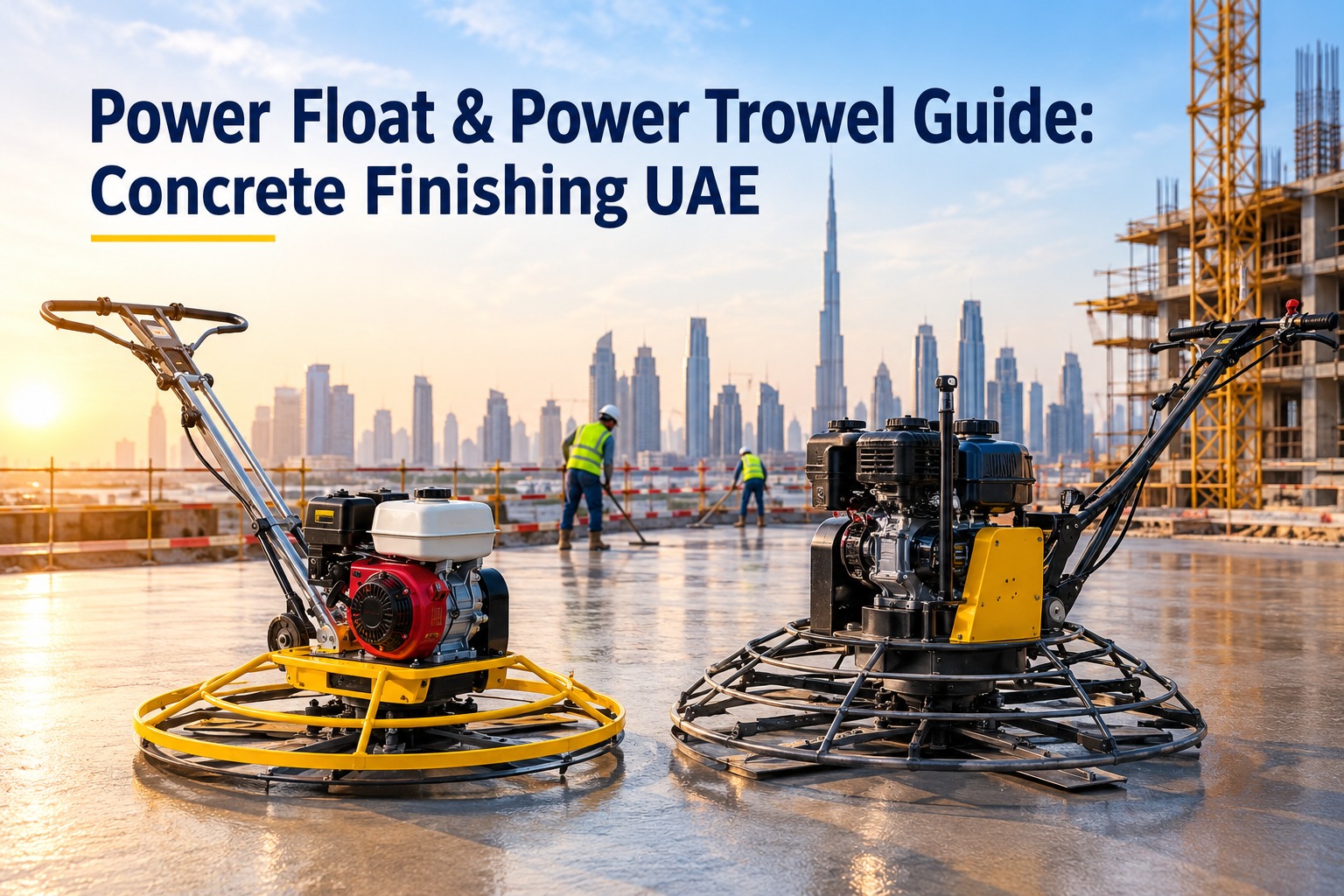
First, the naming confusion: a power float and a power trowel are the same family of machine. UAE sites tend to say “power float,” catalogues say “power trowel,” and old hands say “helicopter” because of the spinning blades. Whatever you call it, it's the machine that turns a bull-floated slab into that hard, smooth, dense surface you see in warehouses and showrooms — a finish no amount of hand trowelling will match on a big pour.
This guide covers what the machine actually does to the concrete, the difference between float and finish blades, when to start (the part everyone gets wrong first), and how to pick a machine for UAE conditions.
AMACO supplies power floats as part of our concrete finishing equipment range, including the Baylorr FLO900-R walk-behind trowel, from Ajman stock with 48-hour UAE delivery.
What a Power Float Actually Does
Fresh concrete, even well-placed and vibrated, sets with a weak skin of laitance — fine particles and water drawn to the surface. A power float's rotating blades work that surface in two stages. Floating embeds the coarse aggregate, closes pores and levels minor highs and lows. Trowelling then compresses and polishes the paste into a dense, hard-wearing skin. The result isn't cosmetic: a machine-finished slab resists abrasion, dusting and moisture far better than a hand-finished one, which is why warehouse and industrial specs demand it.
One thing the float can't do is fix bad concrete underneath. If the pour wasn't consolidated properly, the surface will tell on you — our post on honeycombing and why vibration matters covers that earlier step.
Float Blades vs Finish Blades (and Pans)
- Float blades or a clip-on pan go on first — wide, flat, riding on top of the surface while it's still relatively soft. This is the levelling and closing stage.
- Finish blades are narrower and get pitched at an increasing angle over successive passes, compressing the surface harder each time. This is where the shine and the density come from.
- Combination blades do both jobs acceptably — the practical choice if you own one set and switch between stages by adjusting pitch.
Timing: The Skill That Makes or Breaks the Finish
Start too early and the machine tears the surface and digs in; too late and the blades just burnish concrete that's already gone off. The site test hasn't changed in fifty years: step on the slab. When your boot leaves an impression of about 3–4 mm and no bleed water rises around it, the slab is ready for first floating. In UAE summer that window arrives fast and doesn't wait — on a big pour the finishing crew starts at one end while the far end is still being placed. Plan the pour sequence around the float, not the other way round.
Choosing a Machine for UAE Work
Blade diameter
The common walk-behind sizes run 600 mm to 1,200 mm. Bigger discs cover slab faster; smaller ones get closer to walls and columns and are easier in doorways. A 900 mm machine — the class our FLO900-R sits in — is the balance point for most UAE slab work: fast enough on open floor, manageable at the edges.
Engine
Petrol dominates on UAE slabs for the usual reason: the finish can't wait for a power connection, and trailing a cable across fresh concrete is asking for trouble. A Robin or Honda engine earns its premium on the morning the pour is booked and the machine has to start first pull.
Handle and controls
The operator holds this machine for hours. Look for adjustable handle height, a dead-man safety switch that actually kills the blades when released, and accessible pitch control — you'll adjust blade angle constantly through the finish passes.
Edges and columns
Every machine leaves a border it can't reach. Plan for hand trowelling around columns and edges, or add an edging float to the kit. Pricing the slab job without the hand-finish hours is a classic quoting mistake.
Walk-Behind or Ride-On?
Ride-on twin-rotor machines finish big slabs several times faster and are standard on warehouse projects measured in thousands of square metres. Below that scale, a walk-behind does the same quality of work at a fraction of the machine cost, fits through doors, and one operator can load it on a pickup. Most UAE contractors are walk-behind buyers; ride-ons make sense for dedicated flooring subcontractors.
Keeping It Finishing Well
- Wash the machine after every slab — hardened paste on the spider and blades unbalances the rotation and marks the next floor.
- Replace blades in full sets, not singles; mixed wear leaves swirl marks you'll see in low light forever.
- Check gearbox oil and the clutch monthly in season — the gearbox works hard in slab heat.
When it needs more than maintenance, our Ajman workshop handles repair and servicing for finishing machines of any brand, with genuine Baylorr parts in stock.
Frequently Asked Questions
Yes — they're the same machine family. “Power float” is the common term on UAE sites, “power trowel” in catalogues, and “helicopter” is site slang for the spinning blades.
When a boot print leaves only a 3–4 mm impression with no bleed water. Starting earlier tears the surface; later, and the blades can't work the paste. In UAE heat this window comes quickly.
A 900 mm walk-behind machine suits most UAE slab work — fast on open floor, workable near edges. Go bigger only for large open slabs, or ride-on for warehouse-scale floors.
Any properly placed and vibrated slab with a suitable mix, yes. Very wet mixes, badly consolidated pours or slabs that have gone off too far won't finish well no matter the machine.
Yes. AMACO stocks the Baylorr FLO900-R walk-behind trowel and finishing equipment in Ajman, with 48-hour delivery UAE-wide, one-year warranty and workshop support.