Short answer: the soil decides, not the machine. Plate compactors win on the sandy, granular ground that covers most UAE sites. Tamping rammers win in trenches and on clay-heavy or mixed backfill. Plenty of contractors eventually run one of each — but if you're buying one machine first, this guide will tell you which.
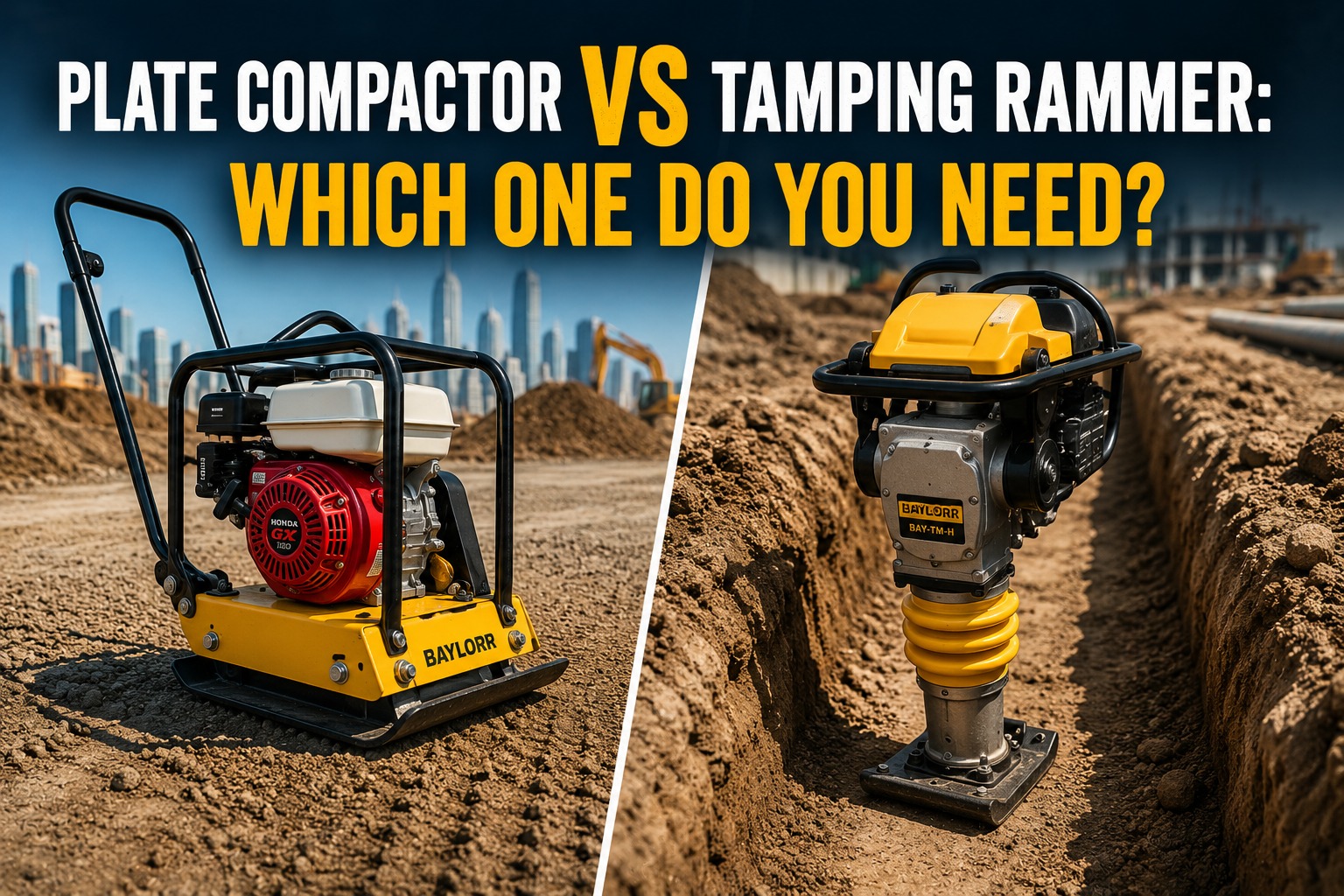
At AMACO we supply both from our compaction equipment range — the 90 kg Baylorr BAY-PC90C plate compactor and the 78 kg BAY-TM-H tamping rammer — so this comparison comes from machines we sell, service and see come back through our Ajman workshop.
The Two Machines at a Glance
| Plate compactor | Tamping rammer | |
|---|---|---|
| How it compacts | High-frequency vibration through a wide flat plate | Percussive vertical blows through a small foot |
| Best soils | Granular: sand, gravel, crushed aggregate, asphalt | Cohesive: clay, silt, mixed backfill |
| Layer (lift) depth | Around 15 cm per pass | Up to 25 cm per pass |
| Working speed | Fast — covers open areas 3–4x quicker | Slower, but concentrated |
| Where it shines | Sub-base, paver beds, driveways, asphalt patching | Trenches, footings, against walls and pipes |
| Typical UAE price | AED 2,000 – 5,500 (90 kg class) | AED 3,000 – 7,000 (70–80 kg class) |
How Each Machine Works
Plate compactor: vibration over area
A plate compactor spins an eccentric weight under a wide steel plate, sending rapid vibration into the ground. The particles shake, rearrange, and lock together. Because the force spreads across the whole plate, it covers open ground quickly and leaves a smooth, even finish — which is why it's the default machine for sub-base, paver beds and asphalt patching.
Tamping rammer: impact in a small footprint
A rammer — the “jumping jack” — drives a small foot up and down in fast, forceful strokes, hammering the ground several hundred times a minute. All that energy lands on a small area, punching air and water out of soils that simply absorb a plate's vibration. Its upright shape turns on the spot and works flush against walls, pipes and footings.
The Deciding Factor: Your Soil
Group site soils into two families and the choice makes itself:
- Granular soils — sand, gravel, crushed aggregate. They don't hold shape when squeezed, and they respond beautifully to vibration. This is the majority of UAE ground and imported sub-base material. Plate compactor territory.
- Cohesive soils — clay and silt that stick together and hold water. Vibration alone deforms them without densifying. They need direct impact. Rammer territory — and exactly what you meet in trench backfill and some coastal and inland clay pockets.
Depth, Speed and Space
- Lift depth: compact roughly 15 cm per layer with a 90 kg plate; a rammer handles lifts up to around 25 cm, which means fewer layers when refilling a deep trench.
- Coverage speed: on an open sub-base a plate finishes the area several times faster and leaves a better surface for the next trade.
- Confined access: a rammer's narrow foot works inside pipe trenches, around utility poles and against foundations where a plate physically can't reach the edge.
What They Cost in the UAE
A quality 90 kg petrol plate compactor runs AED 2,000–5,500 in the UAE; Robin- or Honda-engine tamping rammers in the 70–80 kg class run AED 3,000–7,000. For the full breakdown by weight class — and why cheap imports cost more than they save — see our plate compactor price guide.
So Which Should You Buy First?
Both machines are in stock at our Ajman warehouse with 48-hour delivery UAE-wide to Dubai, Sharjah, Abu Dhabi and beyond, one-year warranty, and servicing and repair for any brand after the sale.
Frequently Asked Questions
A plate compactor compacts through high-frequency vibration spread across a wide plate — best for granular soils like sand and gravel. A tamping rammer compacts through concentrated vertical impact — best for cohesive soils like clay and for trenches.
Not effectively. Clay absorbs vibration and deforms instead of densifying. Cohesive soils need the direct impact of a tamping rammer, optionally finished with a plate pass for surface levelling.
It's the wrong tool — the impact pushes loose sand sideways rather than compacting it. Use a plate compactor on sand, gravel and crushed aggregate.
A tamping rammer. Its narrow foot fits the trench, works against pipe and wall edges, and compacts deeper layers per pass — meaning fewer lifts to refill the trench.
They overlap. A 90 kg plate compactor typically costs AED 2,500–5,500 and a 70–80 kg branded-engine rammer AED 3,000–7,000. Engine brand and build quality move the price more than the machine type.