What Is Concrete Honeycombing — and Why Does It Get Rejected?
Concrete honeycombing refers to voids, cavities, and areas of exposed coarse aggregate on or beneath the surface of hardened concrete. It occurs when air trapped inside freshly poured concrete is not removed before the mix sets — leaving gaps where cement paste and fine aggregate should be.
On UAE projects where third-party structural inspection is mandatory and municipality sign-off is required before the next pour, a honeycombed column, wall, or slab triggers a Non-Conformance Report (NCR), stops the floor cycle, and initiates a remediation process that can take weeks to close out. In the UAE's coastal environment, exposed rebar corrodes rapidly — making honeycombing in structural elements a serious long-term durability issue, not just a cosmetic one.
What Causes Concrete Honeycombing?
Insufficient or no vibration
This is the primary cause. When fresh concrete is poured into formwork, air becomes trapped within the mix — particularly around rebar cages, at pour joints, and at the base of deep elements. Without mechanical vibration, the trapped air does not escape and voids form.
Wrong poker diameter for the element
A poker too large for the rebar spacing cannot penetrate the cage — leaving concrete around the reinforcement unvibrated. A poker too small may not generate sufficient energy to consolidate the full pour cross-section. Matching poker diameter to the element geometry is a technical decision many sites overlook at procurement stage.
Moving the poker too quickly
Effective vibration requires the poker to remain stationary at each insertion for 5–15 seconds, until air bubbles visibly stop rising to the surface. Rushing this process leaves pockets unvibrated between insertion points.
Insertion points too far apart
The effective radius of action of a vibrator poker is typically 6–10 times the poker diameter. Insertion points further apart than twice the effective radius leave unvibrated zones between them.
Vibrating too close to the formwork
Vibrating immediately against the form face pushes aggregate away from the pour surface, leaving a weak paste-rich face. The poker should be kept at least 75–100mm from formwork faces.
Why Petrol Concrete Vibrators Are Standard on UAE Construction Sites
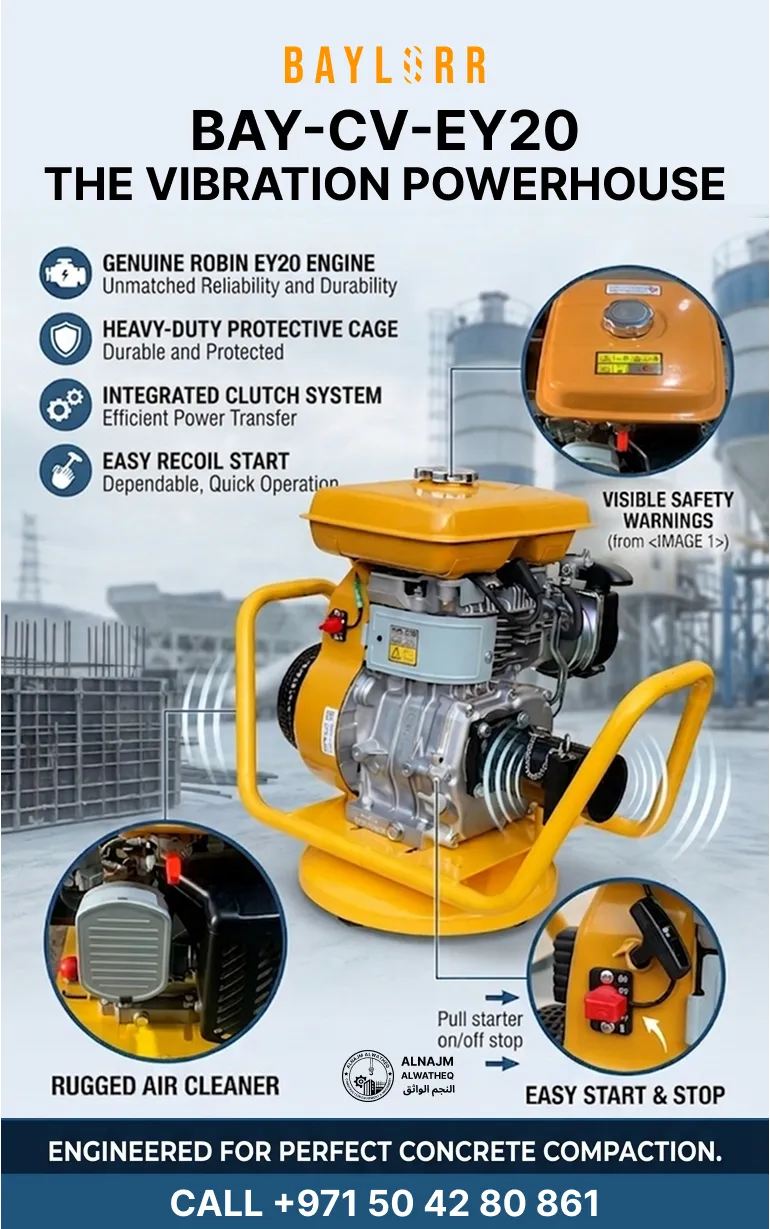
UAE construction sites — particularly on road infrastructure, civils, and low-rise building projects — frequently operate away from permanent power supply. Ready-mix concrete arrives and must be vibrated immediately. A petrol-engine concrete vibrator eliminates the dependency on electrical supply entirely. It starts on site, runs continuously through the pour, and can be repositioned across a large work area without cable management issues.
Honeycombing is not a bad concrete problem. It is a bad vibration problem — and every single case is preventable with the right machine and the right technique.
Key Specifications When Buying a Concrete Vibrator in the UAE
Engine Type and Rating
For UAE outdoor site use, a petrol engine is standard. Robin/Subaru EY series engines are widely used on UAE sites for their heat tolerance and reliability. Confirm the engine is rated for ambient temperatures of 45°C+ without power derating.
Poker (Needle) Diameter
Common diameters used on UAE construction sites:
- 38mm — heavily reinforced columns, walls with tight rebar spacing
- 45mm — general structural elements: beams, columns, walls with standard rebar spacing
- 50mm — slabs, foundations, mass concrete with wide rebar spacing
For most UAE civil and building site applications, a 45–50mm poker covers the majority of pour types. Confirm the machine accepts interchangeable poker heads if multiple element types are involved.
Vibration Frequency (VPM)
- 10,000–12,000 VPM — minimum effective range for structural concrete
- 12,000–15,000 VPM — standard for UAE site structural pours
- 15,000+ VPM — high-performance units for stiff mixes or heavily reinforced elements
Flexible Shaft Length
- 3m — shallow pours, slabs, footings
- 6m — standard for most UAE civil and structural work including columns, walls, and drainage structures
For culverts and deep drainage chambers on UAE road projects, a 6m shaft is the minimum practical requirement.
How to Use a Concrete Vibrator Correctly on Site
-
1
Insert vertically at regular intervals
Space insertion points at no more than 1.5x the effective radius — typically 400–500mm apart for a 45mm poker. Never drag or sweep the poker horizontally.
-
2
Hold for 5–15 seconds per point
Wait until air bubbles visibly stop rising to the concrete surface before moving to the next insertion point.
-
3
Withdraw slowly
Pull the poker out at approximately 75–100mm per second to allow the hole to close without leaving a void.
-
4
Stay 75mm from formwork faces
Vibrating against the form face pushes coarse aggregate away and produces a weak, defective surface.
-
5
Penetrate 150mm into previous lifts at joints
At construction joints, insert the poker 150mm into the previous pour layer to ensure bond across the joint.
Frequently Asked Questions
Minor surface honeycombing can be repaired with approved structural repair mortars, subject to the structural engineer's approval and a documented repair procedure. Deep or extensive honeycombing in structural elements — particularly load-bearing columns and shear walls — may require partial or full demolition and re-pour. The structural engineer makes the final determination. In all cases, an NCR must be raised and closed before the element is accepted.
For typical UAE reinforced concrete columns, a 38–45mm poker is standard. The poker must be able to pass through the rebar cage without displacing the bars. Check the clear spacing between links and main bars against the poker diameter before the pour. If the spacing is tight, use a 38mm poker.
Petrol vibrators operate independently of any power supply — critical on UAE road, infrastructure, and civils sites where pours happen far from generators or distribution boards. They also allow free movement across large pour areas without cable management. Electric vibrators are suited to building sites with consistent power supply close to the work.
Flexible shaft life depends heavily on usage and handling. On active UAE pour schedules, shafts typically last 6–12 months before the inner spiral shows wear that reduces vibration transmission. Inspect the shaft for kinking, worn bearings, and reduced poker vibration regularly. Keeping a spare shaft on site is strongly recommended for any project with a continuous pour programme.