Why Rebar Equipment Is Consistently Under-Specified on UAE Sites
Rebar bending and cutting machines are rarely the headline purchase on a construction project. Budget and attention go to cranes, formwork, and concrete equipment. The rebar machines get sourced at the last minute — and often under-specified as a result.
On UAE structural sites, where pour cycles are fast and steel fixing teams work under tight programmes, an undersized rebar machine becomes the bottleneck that slows the entire floor cycle. A machine that cannot handle the bar diameters on the structural drawings, or that overheats and shuts down in the afternoon heat, costs far more in lost productivity than the saving made at procurement.
Rebar Bending Machines: Key Specifications to Check
Maximum Bar Diameter Capacity
This is the single most important spec. UAE structural drawings typically specify T10 through T32 for standard RC work, with T40 appearing in heavy civil, raft foundations, and bridge work. A machine rated to 32mm only will be unable to process large-diameter bars without the operator forcing the machine — which causes motor strain, accelerated wear, and eventually motor burnout.
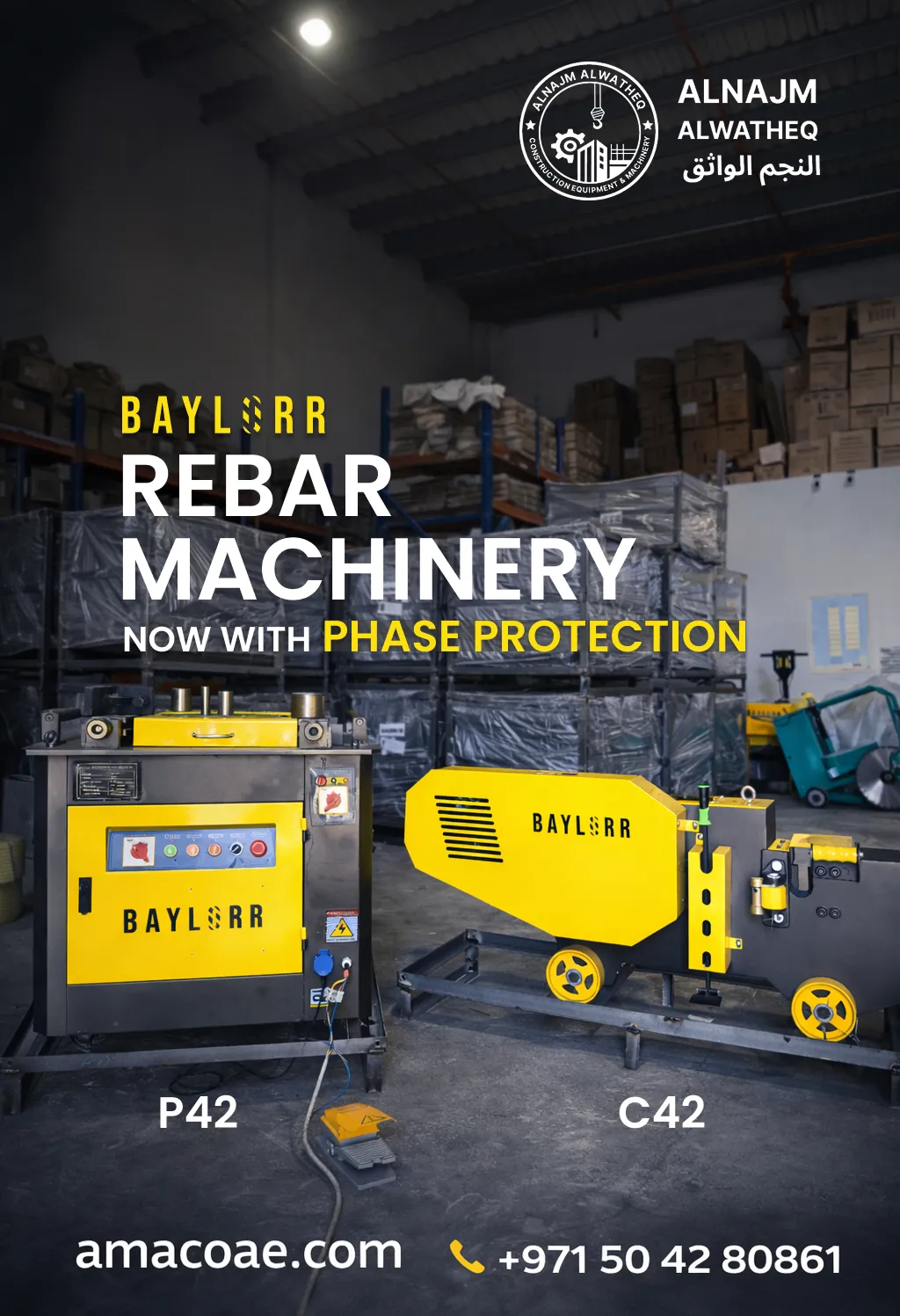
For UAE structural and civil work, a bending machine rated to 40–42mm covers the full range of bar sizes you are likely to encounter across building, road, and infrastructure projects. The BAY-P42 Rebar Bending Machine handles bars up to 42mm — ensuring you are not caught out by larger bar specifications mid-project.
Bending Angle Range
UAE structural detailing requires a full range of bend shapes: 90° stirrups, 135° hooks for seismic detailing, 45° cranked bars, and full 180° U-bars. Confirm the machine delivers the complete 0–180° range with a mechanical stop that can be preset to the required angle. A machine with limited angle adjustment forces operators to estimate, producing inconsistent bends that fail rebar inspection.
Bending Speed
On an active pour floor, a steel fixing team can process hundreds of bars per shift. A slow bending machine — particularly one that requires manual repositioning between each bend — creates queuing at the machine and idle time for the fixing team. Look for machines with adjustable speed control and a turntable design that allows efficient multi-bend shapes in a single setup.
Motor Power and Duty Cycle
UAE summer ambient temperatures regularly exceed 45°C on site. Motors running continuously without adequate thermal protection will overheat and shut down — or burn out entirely. Confirm the motor is rated for continuous duty in high-temperature conditions, and that the machine has built-in overload protection. A motor that trips at 2pm in July on an active structural floor is a serious programme risk.
Machine Weight and Portability
On multi-storey structures, rebar bending machines need to move between floors as the building rises. Machines in the 150–250 kg range can be lifted by the tower crane on a suitable lifting frame. Confirm the machine has certified lifting points and that your crane operator is familiar with the procedure. Machines above this weight become difficult to reposition and tend to stay in one location — reducing flexibility on active floors.
The rebar bending machine is the first step in the steel fixing cycle. If it cannot keep pace with the fixing team, the entire floor programme slips — and no amount of overtime recovers lost pour days.
Rebar Cutting Machines: Key Specifications to Check
Maximum Cutting Diameter
As with bending machines, the cutting capacity must match the largest bar diameter on the structural drawings. For UAE structural work, a machine rated to 40–42mm covers the full range. The BAY-C42 Rebar Cutting Machine handles bars up to 42mm and is designed for the bar sizes common across UAE building, civils, and infrastructure projects.
Cutting Speed and Blade Life
Cutting speed is typically expressed in cuts per minute. For production cutting on an active structural floor, look for machines that can complete a clean cut on T20 bar in under 5 seconds. Blade wear is directly linked to the hardness of the bar stock — UAE rebar grades (typically Grade 60 / B500) are harder than lower-grade material, so confirm the cutting blades are rated for high-yield steel.
Motor Overload Protection
Cutting thicker bars places significant load on the motor. Without adequate overload protection, a machine cutting T32 or T40 bars at pace will generate sustained high current draw that overheats the motor. Confirm the machine has thermal overload protection that trips before damage occurs — and resets quickly so the machine can return to service without waiting for a cool-down period.
Blade Replacement Access
On an active cutting station, blade changes need to be fast. Confirm the blade change procedure requires minimal tooling and can be done by an operator in the field without specialist support. Machines where blade access requires disassembly cause extended downtime at the worst possible moments.
Rebar Bending vs Cutting: Do You Need Both?
On most UAE structural projects, the answer is yes — but the ratio depends on the work type.
For building structures with repetitive floor plates, bending machines carry the higher utilisation — stirrups, links, and cranked bars dominate the bar schedule. One bending machine per two active fixing teams is a common starting point.
For civil and infrastructure work — drainage, culverts, retaining walls, and bridge abutments — cutting machines often run continuously as bars are cut to length from stock. The cutting machine is on the critical path; the bending machine handles the shaped elements separately.
For most UAE structural sites, one bending machine and one cutting machine per active floor or work front is the minimum. Factor in a standby unit for large projects where a breakdown would halt steel fixing across multiple teams.
What to Confirm Before Purchasing
-
1
Check the full bar schedule before ordering
Identify the largest bar diameter on the structural drawings — not just the most common size. The machine must handle the maximum, not just the average.
-
2
Confirm motor rating for UAE temperature conditions
Request confirmation that the motor is rated for continuous operation at 45°C+ ambient. Ask specifically — motor datasheets often quote performance at 20°C.
-
3
Verify local spare parts availability
Cutting blades, bending pins, and motor components are the highest-wear items. Confirm these are stocked in the UAE before purchase — not after the first breakdown on an active pour floor.
-
4
Plan for standby units on large projects
For projects with multiple active fixing fronts, budget for at least one standby machine. Steel fixing is on the critical path of every poured structure — a single day's delay has a direct programme cost.
Frequently Asked Questions
For standard RC building structures in the UAE, T10 through T32 covers the majority of bar schedules — columns, beams, slabs, and walls. T40 and T42 bars appear in heavy civil work, raft foundations, transfer plates, and bridge elements. A machine rated to 42mm ensures full coverage across all project types without being caught short on larger diameter work.
Yes — machines in the 150–250 kg range can be craned to upper floors using certified lifting points on the machine frame. Confirm with your supplier that the machine has proper lifting lugs and a safe working load rating. The crane operator must use a suitable lifting frame or spreader bar. On high-rise projects, some contractors pre-fabricate rebar cages at ground level and crane them up assembled — reducing the need for heavy equipment on upper floors.
Blade life varies significantly by bar diameter, steel grade, and daily cutting volume. On a busy structural floor cutting Grade 60 bars, blades may need replacement every 2–4 weeks. Inspect blades daily for visible chipping or rounding of the cutting edge — a worn blade requires higher motor force per cut, accelerating motor wear. Always keep at least two spare blade sets on site during active cutting operations.
AMACO stocks the BAY-P42 rebar bending machine and BAY-C42 rebar cutting machine with spare parts availability across the UAE. Both machines are rated for the bar diameters and operating conditions common on UAE structural and civil sites. Contact us at amacoae.com to discuss your project requirements or browse the full range at amacoae.com/products.