Why Trench Compaction Failures Are So Costly on UAE Sites
When a municipality inspector or third-party quality engineer rejects a compaction result, work stops immediately. The trench must be reopened, the backfill reworked, re-testing scheduled, and the inspection resurveyed. On projects with tight programmes, that sequence costs days and triggers contractual penalties.
In most cases, the root cause is not the soil or the operator. It is using the wrong machine — specifically, using a plate compactor in a situation that requires a tamping rammer.
What Is a Tamping Rammer?
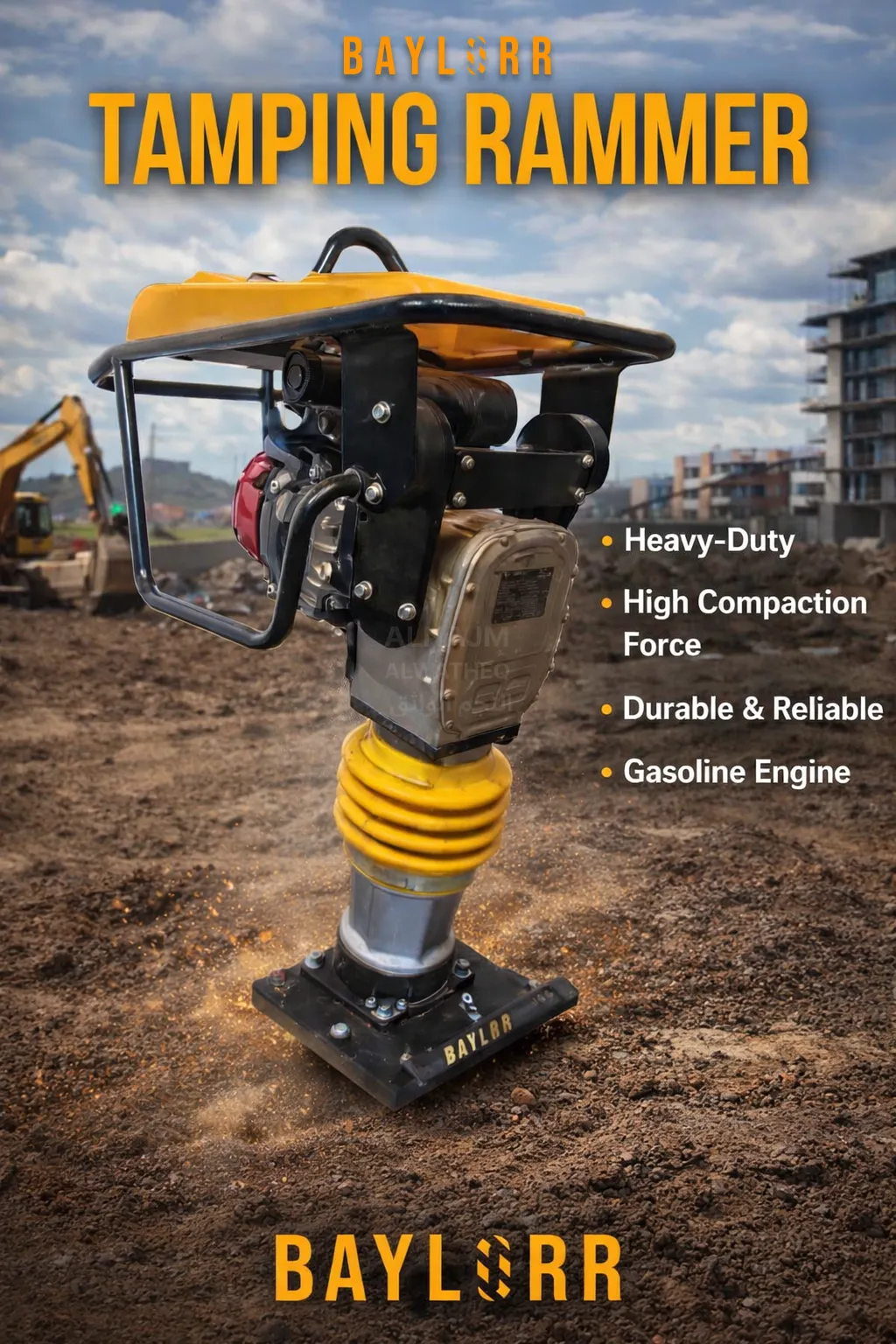
A tamping rammer — also called a jumping jack compactor, trench rammer, or soil rammer — is a compaction machine that delivers high-impact vertical blows into the soil through a small shoe (typically 280mm x 330mm). Unlike a plate compactor, which applies vibratory energy across a wide flat plate, the rammer concentrates impact force through a small footprint — making it capable of reaching the bottom of narrow trenches and compacting in confined spaces layer by layer.
When You Need a Tamping Rammer Instead of a Plate Compactor
Use a tamping rammer when:
- The work area is a narrow trench — drainage pipes, water mains, telecommunications ducts, electrical cable runs, gas lines
- The soil type is cohesive — clay, silty clay, or mixed cohesive soils that do not respond to vibratory plate compaction
- The compaction depth per layer exceeds what a plate compactor can achieve
- The trench geometry prevents a plate from sitting flat — curved corners, pipe haunches, and narrow widths all create voids a plate cannot reach
- Specifications require 95%+ MDD in cohesive backfill — very difficult to achieve with a plate compactor on clay soils
Why Trench Compaction Fails: The Most Common Causes
Wrong machine for the soil type
Plate compactors rely on vibration to rearrange granular particles. They are ineffective on cohesive soils because clay particles do not respond to vibration — they require impact force. A tamping rammer delivers the vertical energy needed to compact clay and silty soils to specification.
Compacting in layers that are too thick
A common site error is backfilling a trench in one or two lifts and attempting to compact the full depth at once. Tamping rammers compact effectively in 150–300mm loose layers. Thicker lifts result in surface densification with loose material below — which may pass a surface test but fails a deep density check.
Insufficient machine weight for the application
Lighter rammers (50–55 kg) suit shallow compaction work. For deep trench backfill in cohesive soils — where trench depths of 1.5–3m are common on UAE road projects — a heavier machine with higher impact force is required.
Inadequate moisture content in the backfill
In the UAE's arid climate, imported or excavated backfill dries out quickly on site. Achieving Optimum Moisture Content (OMC) is the site team's responsibility — but the right rammer makes it achievable even at the lower end of the acceptable moisture range.
Most failed trench compaction tests on UAE sites are not a soil problem or an operator problem. They are a machine selection problem — and they are entirely preventable at procurement stage.
Key Specifications When Buying a Tamping Rammer in the UAE
Impact Force (kN)
Impact force determines compaction effectiveness in cohesive soils. For UAE trench compaction in clay-bearing soils, look for a minimum of 14–16 kN. Higher-impact models (18 kN+) suit deep trenches with heavily cohesive backfill.
Blow Frequency (BPM)
Standard tamping rammers operate at 500–700 BPM. Higher frequencies are more productive on large trench volumes but must be balanced against operator fatigue on extended shifts.
Shoe Size
Smaller shoes concentrate more force per unit area — better for stiff cohesive soils. Larger shoes cover more area per blow — better for granular or mixed soils. Standard sizes for UAE site use: 280mm x 330mm to 330mm x 380mm.
Machine Weight
For deep trench compaction in UAE conditions, machines in the 60–75 kg range offer the best combination of effectiveness and operator manageability. Units below 55 kg are suited to shallow surface compaction only.
Engine Type and Heat Performance
UAE summer temperatures regularly exceed 45°C on site. Confirm that the engine's rated output is tested for high-temperature environments. Petrol-engine rammers from Honda or Robin/Subaru engine platforms are standard on UAE sites for their proven heat tolerance.
Tamping Rammer vs Plate Compactor: Quick Reference
Which machine for which application?
Tamping rammer: Cohesive soils (clay, silt, mixed) · Narrow trenches · Pipe haunches · Deep backfill layers up to 300mm · 95%+ MDD in confined spaces
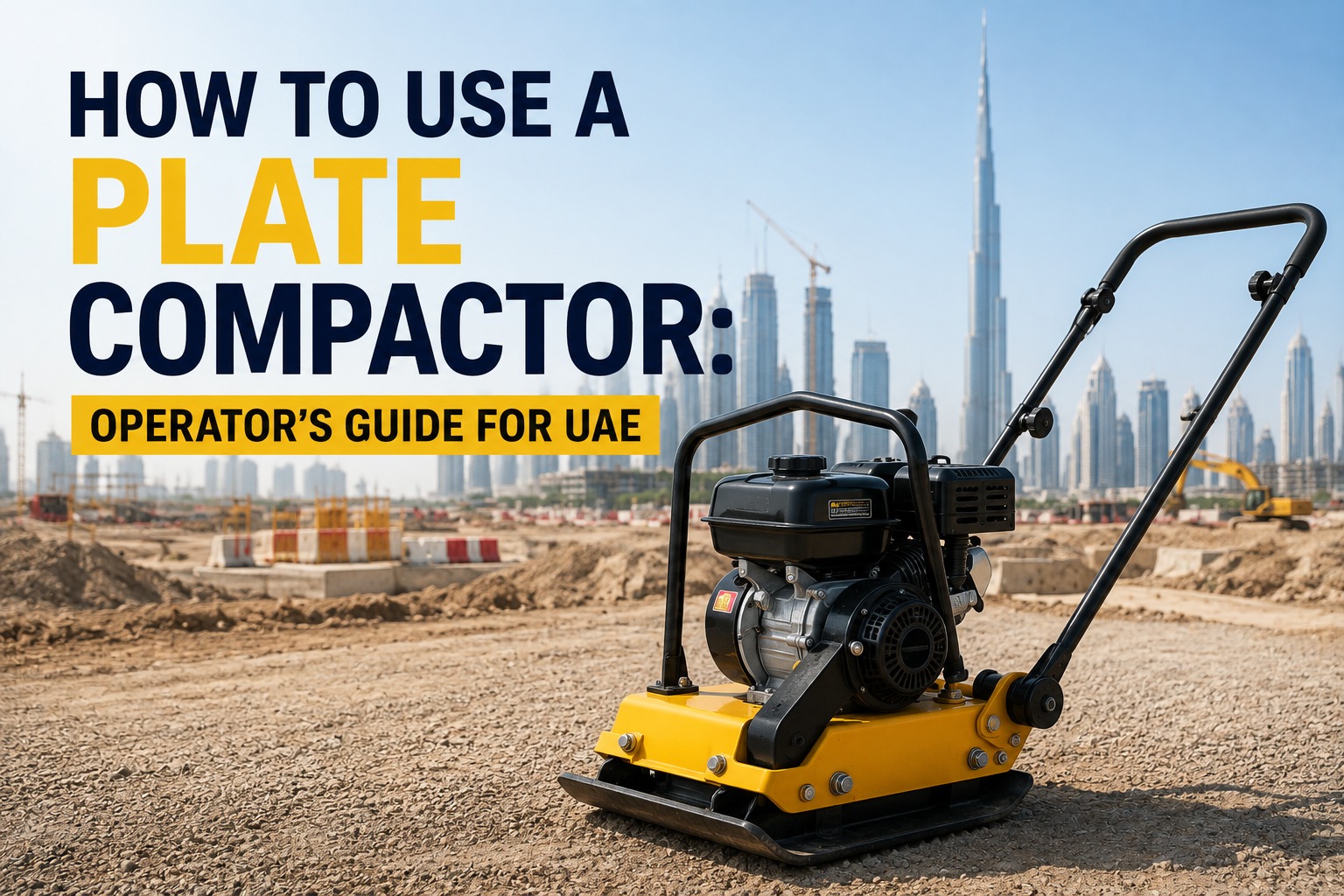
Plate compactor: Granular soils (sand, gravel, sub-base) · Open flat areas · Road formation · Interlock bedding · Wide trench backfill in granular material
What to Confirm Before Purchasing
-
1
Match impact force to soil type and trench depth
Request the full technical datasheet. Confirm impact force (kN) and blow frequency (BPM) against your project's soil investigation data.
-
2
Verify engine heat rating
Confirm the engine is rated for 45°C+ ambient operation. Ask specifically — don't assume.
-
3
Check spare parts availability in the UAE
Shoe plates, engine filters, belts, and springs are the highest-wear components. Confirm all are stocked locally before purchase.
-
4
Plan for standby units on large projects
For projects with multiple active trenching fronts, budget for at least one standby rammer per three active units.
Frequently Asked Questions
Clay particles do not respond to vibration — they require impact force to rearrange and densify. A plate compactor applies vibratory energy suited to granular materials. On cohesive soils, it densifies the surface layer while leaving loose material below, producing a result that appears compacted but fails a deep density test.
Tamping rammers compact effectively in 150–300mm loose layers, depending on machine weight and soil type. For UAE trench backfill in cohesive soils, work in 150–200mm layers to ensure density is achieved throughout each lift, not just at the surface.
Yes — a tamping rammer can be used on granular backfill in confined trenches where a plate compactor cannot reach. However, a plate compactor is more productive on open granular areas. In practice, on UAE sites, both machines are typically deployed simultaneously for different applications.
Backfill should be placed at or near its Optimum Moisture Content (OMC), as determined by a Proctor compaction test on the specific material. In UAE conditions, imported fill dries out quickly — water the material in layers before compacting, particularly in summer months when surface evaporation is rapid.