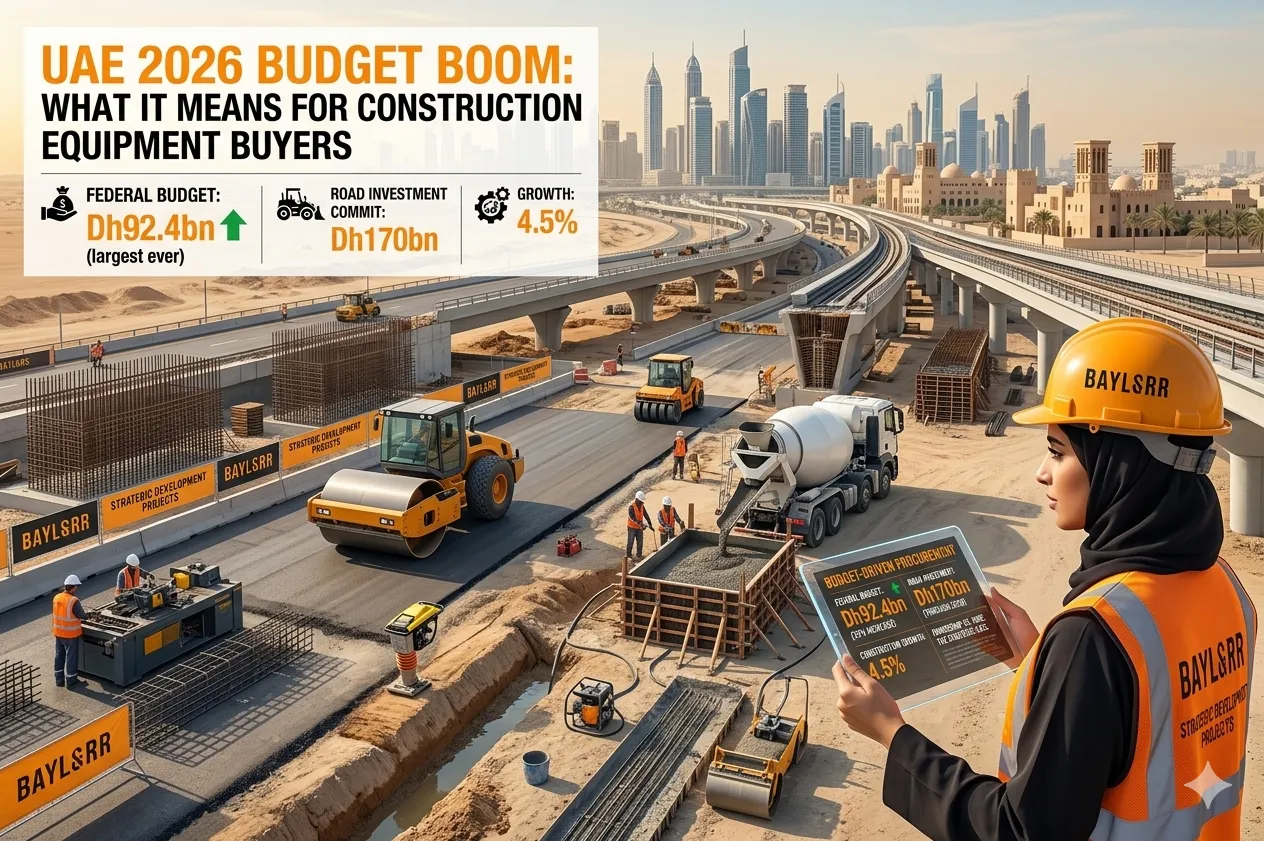
The Numbers: UAE 2026 Budget at a Glance
The UAE Cabinet approved a federal budget of Dh92.4 billion ($25.2 billion) for 2026 — a 29% increase over the Dh71.5 billion budgeted in 2025, and the largest in the country's history. The budget is balanced for the fourth consecutive year, with revenues and expenditures fully aligned.
For procurement managers, site engineers, and contractors sourcing construction equipment in the UAE, these numbers translate directly into project volume — and project volume drives equipment demand. Understanding what is being funded, where projects are concentrated, and which equipment categories face the highest demand gives buyers a meaningful advantage when planning purchases and avoiding supply shortages.
What the Construction Growth Figures Mean for Equipment Demand
GlobalData projects UAE construction industry growth of 4.5% in real terms in 2026, followed by an average annual growth rate of 3.9% between 2027 and 2029. That sustained multi-year trajectory — supported by transport, housing, energy, and utilities investment — means equipment demand will not spike and subside. It will remain elevated across the entire planning horizon.
For procurement managers, this has a practical implication: equipment sourced today for a current project is likely to be needed again on the next one. Buying decisions made in 2026 should factor in a 3–4 year utilisation horizon, not just the immediate project requirement.
With the UAE's construction growth averaging 3.9% annually through 2029, equipment purchased in 2026 will be deployed across multiple project cycles. This is not a timing question — it is a cost-per-project question.
Which Project Types Are Receiving Funding — and What Equipment They Require
Road and Transport Infrastructure
The Dh170 billion road and transport investment plan is the single largest driver of civil construction equipment demand in the UAE through 2030. Active delivery in 2026 means continuous demand for plate compactors and tamping rammers for sub-base and trench compaction, concrete mixers for kerb and drainage works, concrete vibrators for structural civil elements, and rebar bending machines for on-site cage fabrication.
Parks, Landscaping, and Public Realm
Dubai's Dh18.3 billion Parks and Greenery Strategy — 800 projects spanning new parks, open spaces, and recreational infrastructure — is an often-overlooked source of civil equipment demand. Park construction involves extensive drainage installation, pathway construction, and hardscape. The equipment requirements mirror road civils work: plate compactors for path sub-bases, tamping rammers for drainage trench backfill, and concrete mixers for footings and edgings.
Metro, Airport, and Major Infrastructure
The Blue Line metro extension, Al-Maktoum Airport, and Dubai Strategic Sewerage Tunnels project collectively represent tens of billions of dollars in active civil construction. The subcontractor supply chains feeding these projects — covering drainage connections, road diversions, utility relocations, and surface reinstatement — will be sourcing civil construction equipment throughout 2026 and beyond.
Housing and Residential Development
The "We the UAE 2031" vision includes significant residential development targets. Housing project activity supports demand for on-site concrete equipment — particularly mixers and vibrators — on mid-rise and villa developments where site-batched concrete is used for footings, columns, and slabs.
Buy vs Hire: Making the Case for Ownership in a Growth Market
When construction activity is at peak, hire rates increase and availability tightens. During periods of high project mobilisation — which 2026 represents — lead times for hired equipment extend and preferred specifications are often unavailable at short notice. The calculus shifts toward ownership:
The ownership case in numbers
Availability certainty: Owned equipment is available when needed, regardless of market conditions. Hire fleets are finite — and in a peak market, they are committed.
Break-even timeline: For standard civil site equipment — plate compactors, tamping rammers, concrete mixers — the ownership cost typically breaks even against hire at 3–5 months of use. In a sustained project environment, that threshold is crossed within the first deployment.
Multi-project value: With a 3–4 year construction growth cycle ahead, equipment purchased in 2026 delivers value across multiple project cycles — not just the immediate one.
What Procurement Managers Should Do Now
-
1
Plan equipment requirements ahead of project award
In a high-activity market, waiting until after award to begin procurement introduces risk. Equipment available on short notice in a quieter market may have multi-week lead times when demand is high.
-
2
Confirm spare parts availability before purchasing
With multiple large projects running simultaneously, demand for spare parts increases alongside equipment demand. Confirm local stock of critical components before purchase — not after the first breakdown.
-
3
Standardise on a supplier with UAE after-sales coverage
Equipment downtime on a UAE infrastructure project has a direct programme cost. Standardising on suppliers with proven UAE service coverage reduces the risk of being stranded with a breakdown and no local repair support.
-
4
Match specifications to project type, not just budget
In a high-utilisation environment, an undersized machine costs more in downtime and rework than the saving at purchase. Confirm specifications against actual site conditions before committing to a purchase order.
Frequently Asked Questions
Dubai and Abu Dhabi account for the largest share of active project volume, driven by the airport expansion, metro extension, road programmes, and housing development. Sharjah and the Northern Emirates are also seeing increased infrastructure activity, particularly in road improvements and utility upgrades aligned with federal budget allocations. For equipment suppliers, this means demand is distributed across all emirates — not concentrated in a single market.
For contractors with an active project pipeline extending beyond 3–4 months, ownership is the lower-cost option in the current UAE market. Hire rates increase during periods of peak activity, and availability of preferred specifications tightens. The break-even point for owning standard civil equipment — compactors, rammers, mixers — against hire cost is typically 3–5 months of use. In a sustained growth environment, that threshold is crossed on the first project.
Based on the funded project types, the highest demand will be in soil compaction equipment (plate compactors, tamping rammers) driven by road and drainage work, concrete site equipment (mixers, vibrators) for kerb, drainage, and structural civils, and steel fixing equipment (rebar benders) for structural packages across building and infrastructure projects. These are the equipment categories directly on the critical path of UAE road, transport, and housing work.
GlobalData projects an average annual construction industry growth rate of 3.9% between 2027 and 2029, following 4.5% growth in 2026. The committed pipeline — Dh170bn road programme, Al-Maktoum Airport, Blue Line metro, Dubai sewerage tunnels, and the We the UAE 2031 development agenda — provides a visible workload extending well beyond 2026. Equipment procurement decisions made in 2026 should be planned against a 3–5 year utilisation horizon.